Best Supplements for Knee Pain After 40: What Actually Works

Active 45+ adult walking confidently outdoors
Your Knees Aren’t “Old.” They’re Under-Supported.
Climbing stairs shouldn’t feel like a negotiation.
Yet somehow, after 40, your knees begin to protest. First quietly. Then consistently.
At first, you ignore it. Later, it becomes harder to dismiss.
Here’s what most people overlook: knee pain after 40 isn’t simply aging. Instead, it’s usually a mix of cartilage thinning, inflammation, and slower recovery.
Because of that, choosing the best supplements for knee pain becomes less about hype and more about strategy.
In this guide, you’ll discover:
-
Why do knees deteriorate faster after 40
-
Which ingredients actually work (and which waste money)
-
How to choose a formula that supports structure and inflammation
-
What multiplies your results naturally
If you want a complete overview of combination formulas for all joints, start with our in-depth guide on joint pain supplements that work. It lays the foundation.
Why Knee Pain Accelerates After 40 (And Why It’s Not Random)
Cartilage doesn’t regenerate quickly. Meanwhile, collagen production declines each year. At the same time, inflammatory markers tend to rise.
Consequently, your knees—which absorb enormous daily loads—begin to feel it first.
Picture your knee like a shock absorber in a vehicle. Over time, the cushioning thins. Without proper lubrication, friction increases. Eventually, stiffness appears.
Common warning signs include:
-
Morning stiffness lasting longer than 10 minutes
-
Pain when descending stairs
-
Grinding or clicking sensations
-
Swelling after mild activity
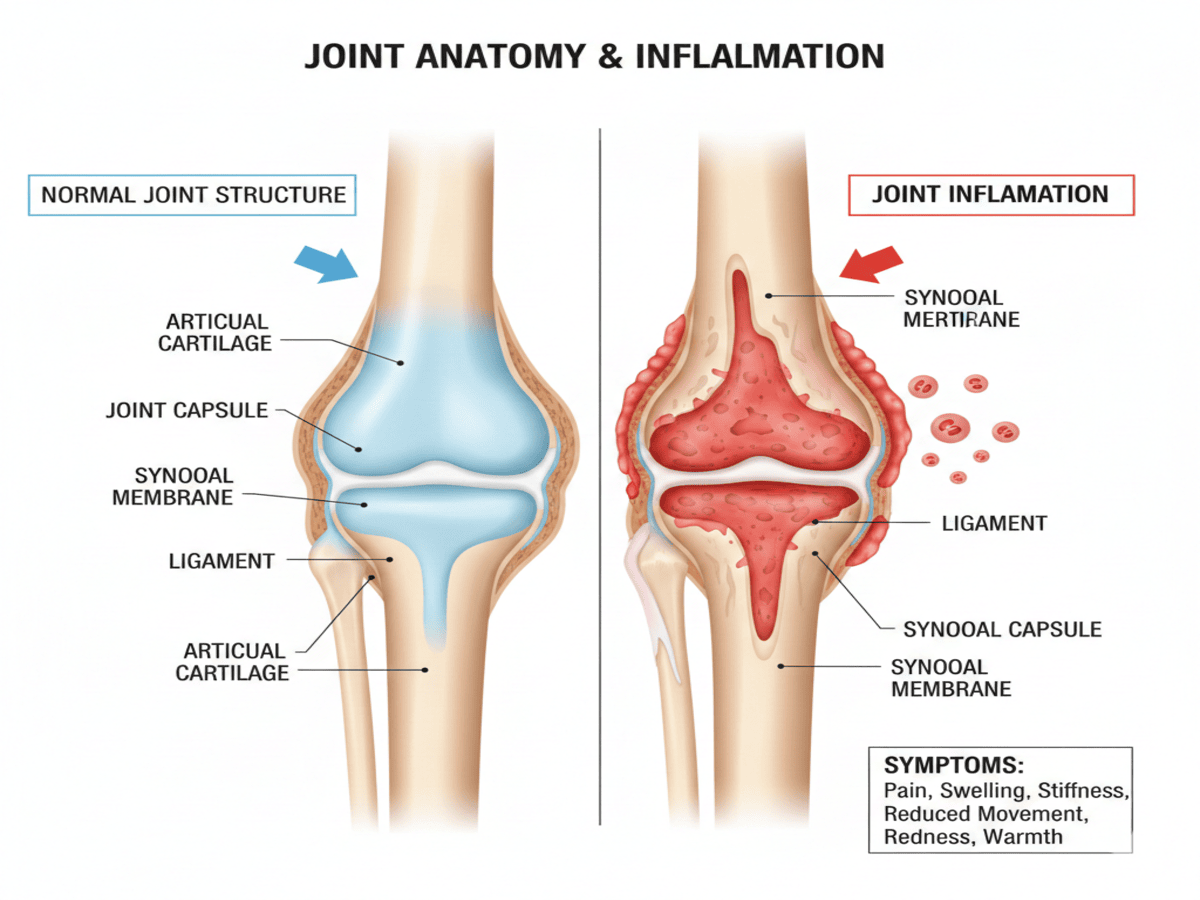
Knee structure infographic:
When these symptoms show up, masking pain isn’t enough. Structural support becomes essential.
The Science Behind the Best Supplements for Knee Pain
Scientific research consistently points toward certain nutrients.
For example, the National Institutes of Health has reviewed glucosamine and chondroitin for knee joint support, noting symptom improvement in some individuals.
Similarly, the Mayo Clinic recognizes turmeric (curcumin) for its anti-inflammatory properties.
In addition, studies indexed in PubMed show that omega-3 fatty acids help regulate inflammation associated with joint stiffness.
Furthermore, the Arthritis Foundation emphasizes a combined approach: weight management, movement, and nutritional support.
What That Really Means for You
Rather than relying on one ingredient, the most effective strategy combines:
-
Cartilage support
-
Inflammation control
-
Joint lubrication
-
Collagen reinforcement
That layered approach explains why comprehensive formulas outperform single-ingredient capsules.
For a broader breakdown across all joints, revisit our pillar guide on joint pain supplements that work before deciding.
The 5 Ingredients That Separate Real Relief from Marketing
Below are the ingredients consistently supported by research and clinical use.
| Ingredient | What It Does | Best For |
|---|---|---|
| Glucosamine Sulfate | Maintains cartilage | Early stiffness |
| Chondroitin | Improves shock absorption | Activity pain |
| Turmeric (Curcumin) | Reduces inflammation | Swelling |
| Collagen Peptides | Supports connective tissue | 40+ adults |
| Omega-3 Fatty Acids | Lowers inflammatory markers | Chronic stiffness |
Importantly, biology works in systems. Therefore, combination formulas typically produce better outcomes.
Glucosamine: Structural Maintenance
Glucosamine serves as a building block of cartilage.
Over several weeks, consistent use may reduce stiffness in mild-to-moderate knee discomfort. However, results improve when paired with complementary ingredients.
Patience matters here. Structural support doesn’t happen overnight.
Turmeric: The Inflammation Regulator
Inflammation often drives pain more than degeneration itself.
Because curcumin targets inflammatory pathways, many people experience improved mobility when swelling decreases.
Absorption, however, is critical. Look for enhanced bioavailability formulas.
Collagen: The Quiet Reinforcer
After 40, collagen loss accelerates. Consequently, connective tissue weakens.
Supplemental collagen helps reinforce the joint framework over time. Although subtle at first, long-term users often report improved flexibility.
Ever notice how top-rated knee formulas almost always include collagen? That’s not a coincidence.
The Knee Supplement Most Readers End Up Choosing
Many readers prefer a multi-ingredient formula that includes glucosamine, turmeric, collagen, and joint-support cofactors.
Because it combines structural and anti-inflammatory support, it aligns with the research-backed strategy discussed above.
👉 See the advanced knee support formula here →
Instead of jumping between single ingredients, this option simplifies consistency.
Additionally, if you want to compare broader joint formulas before committing, review our complete breakdown of joint pain supplements that work first.
How to Choose the Right Supplement for Your Knees
If your symptoms are mild, start with glucosamine-based support.
On the other hand, if swelling dominates, prioritize turmeric and omega-3 inclusion.
Meanwhile, adults over 40 thinking long-term should focus on comprehensive blends rather than isolated ingredients.
Budget matters. Consistency matters more.
Without regular use, even the best supplement won’t deliver results.
Lifestyle Changes That Double Your Results
Supplements create internal support. However, habits amplify the outcome.
Anti-Inflammatory Diet Adjustments
- First, increase fatty fish consumption.
- Next, reduce processed sugars.
- Then, add leafy greens daily.
- Finally, hydrate consistently.
Each small shift compounds over time.

Anti-inflammatory meal
Sleep, Stress & Smart Movement
- Quality sleep accelerates tissue repair.
- Chronic stress, meanwhile, elevates inflammatory hormones.
- Gentle strength training, light walking, and controlled mobility exercises lubricate joints naturally.
- Together, these habits work synergistically with supplementation.
Natural Support vs. Painkillers: What’s Smarter Long-Term?
| Approach | Pros | Cons | Best For |
|---|---|---|---|
| Natural Supplements | Sustainable support | Slower onset | Mild to moderate pain |
| NSAIDs | Fast relief | Possible GI/cardiac risks | Acute pain |
| Combined Strategy | Balanced approach | Requires guidance | Long-term care |
Quick relief has value. Long-term joint preservation has more.
Strategic thinking beats reactive treatment.
When You Should See a Doctor
Seek medical guidance if:
-
Swelling becomes severe
-
Knee feels unstable
-
Pain worsens suddenly
-
No improvement after 6 weeks
Although supplementation helps many people, persistent symptoms require evaluation.
Key Takeaways
✅ Knee pain after 40 usually involves inflammation plus cartilage wear
✅ Combination formulas outperform single ingredients
✅ Collagen, glucosamine, turmeric, and omega-3s lead research
✅ Lifestyle adjustments multiply supplement benefits
✅ Early action produces better outcomes
Final Thoughts: Your Knees Still Have Mileage Left
Pain doesn’t mean decline is inevitable.
Instead, it often signals insufficient support.
By combining evidence-backed ingredients with smart movement and recovery habits, you create an environment where joints can function more efficiently.
If you’re ready to take action, explore the advanced knee support formula here →
(Insert Digistore24 link)
And before making a final decision, compare options inside our master guide on joint pain supplements that work to ensure the best long-term strategy.
FAQs: Best Supplements for Knee Pain
How long do knee supplements take to show results?
Most users notice improvement within 4–8 weeks. Structural repair requires consistency.
Are knee supplements safe long-term?
Generally, well-formulated supplements are tolerated well. Nevertheless, consult a healthcare provider if you take medication.
Can I combine supplements with pain medication?
Often yes, but interactions are possible. Therefore, medical guidance is recommended.
Should I take them in the morning or at night?
Taking supplements with meals improves absorption. Timing matters less than consistency.
How do I measure progress?
Look for reduced stiffness, easier stair climbing, and faster recovery after activity.